
Industrial Air Compressor Supplier in Uttar Pradesh: Complete Buyer’s Guide 2026
Introduction
An industrial air compressor supplier in Uttar Pradesh helps businesses source compressed-air equipment and related accessories for manufacturing, processing, packaging, automation, and other industrial operations. Selecting the right supplier involves more than comparing machine prices. Buyers must consider air pressure, flow rate, operating hours, energy consumption, maintenance requirements, and the availability of technical support.
Uttar Pradesh has a diverse industrial base that includes automotive components, engineering, food processing, rice mills, textiles, pharmaceuticals, and other manufacturing activities. Industrial centres such as Kanpur, Lucknow, Noida, Ghaziabad, Varanasi, and Gorakhpur have different compressed-air requirements depending on their production processes. Reliable compressed-air systems can help businesses operate pneumatic machinery, control production equipment, and maintain consistent manufacturing performance.
However, selecting unsuitable equipment can lead to pressure fluctuations, excessive electricity consumption, moisture-related problems, and unexpected downtime. These challenges make it important to evaluate the complete compressed-air system rather than focusing exclusively on the compressor.
This guide explains the main types of industrial air compressors, their applications, important selection criteria, maintenance requirements, operating costs, and compliance considerations. It also explains how businesses can evaluate suppliers such as Electrica when sourcing air compressors and related equipment in Uttar Pradesh.
Market Overview: Industrial Air Compressor Requirements in Uttar Pradesh
Compressed air is an important utility in many industrial facilities. It powers pneumatic tools, operates automated machinery, supports packaging processes, and supplies air to equipment requiring controlled pressure.
Businesses must address several challenges when choosing an industrial compressor.
Energy consumption: Compressors can consume substantial electricity, particularly when operating continuously or under inefficient load conditions.
Variable air demand: Production lines may experience significant changes in air consumption during different shifts or manufacturing cycles.
Air quality: Moisture, particles, and oil contamination can affect equipment performance and product quality.
Maintenance and downtime: Poor servicing, blocked filters, and air leakage can reduce system efficiency and interrupt production.
Local technical support: Access to appropriate installation assistance, replacement parts, and maintenance services can influence equipment reliability.
Accordingly, businesses searching for an industrial air compressor supplier in Uttar Pradesh should evaluate equipment suitability, technical expertise, product availability, and after-sales support together.
Types of Industrial Air Compressors and Available Solutions
Different compressor technologies serve different operating requirements. Understanding their differences helps buyers identify suitable equipment for their facilities.
|
|
|
|
|
|
|
|
|
|
|
|
|
|
|
|
|
|
|
|
|
|
|
|
|
|
|
|
|
|
The correct choice depends on required pressure, airflow, operating hours, air quality, and production patterns. For example, a small workshop with intermittent demand may benefit from a reciprocating compressor, while a manufacturing plant operating throughout multiple shifts may need a rotary screw system.
Industrial Air Compressor Products and Supporting Equipment
An effective compressed-air installation consists of more than the compressor itself. Supporting equipment helps control moisture, remove contaminants, store compressed air, and distribute it throughout the facility.
1. Industrial Air Compressors
Industrial compressors generate the pressure and airflow required by pneumatic equipment and production machinery. Buyers should assess the manufacturer's rated performance, operating efficiency, service requirements, and suitability for the intended application.
For continuous manufacturing operations, a rotary screw compressor may be appropriate. Smaller facilities with intermittent demand may require a different configuration.
2. Air Dryers and Filtration Equipment
Compressed air often contains water vapour and airborne particles. As the air cools, moisture can condense inside pipelines, receivers, and downstream equipment.
Air dryers reduce moisture, while appropriately selected filters remove specified contaminants. The required treatment depends on the application, environmental conditions, and air-quality requirements.
3. Air Receivers and Distribution Components
Air receivers store compressed air and help manage short-term fluctuations in demand. Properly designed piping distributes air to different production areas while limiting pressure losses.
Receiver capacity, piping dimensions, pressure ratings, and safety provisions must be selected according to the system design and applicable requirements.
4. Compressor Accessories and Spare Parts
Filters, separators, valves, hoses, lubricants, and other compatible components contribute to reliable operation. Using appropriate replacement parts and following maintenance schedules can help reduce avoidable breakdowns.
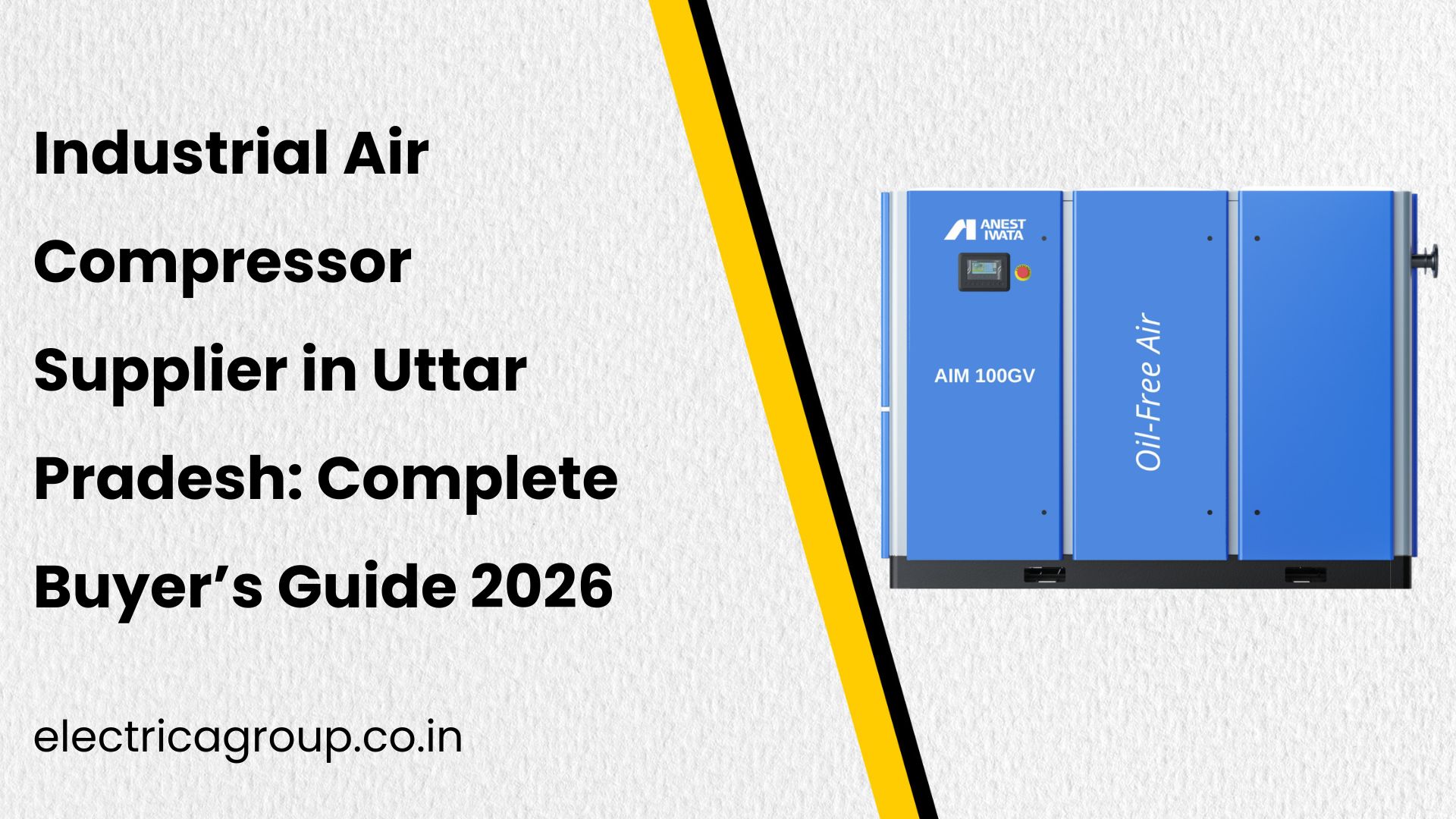
Electrica provides industrial equipment solutions through its compressed-air and machinery offerings, alongside its association with Anest Iwata products. Businesses evaluating Electrica can enquire about suitable compressor options, accessories, and equipment availability based on their application. Product specifications and service coverage should be confirmed directly before purchasing.
Industry-Specific Applications of Industrial Air Compressors
Compressed-air requirements differ considerably between industries. Matching the equipment to the application helps improve reliability and control operating costs.
Food Processing and Rice Mills
Rice mills and food-processing facilities may use compressed air for pneumatic equipment, packaging machinery, material handling, and automated controls. Moisture management is particularly important because water contamination can damage pneumatic components and affect process hygiene.
The required air-treatment system should be selected according to the intended use and applicable food-safety requirements.
Automotive and Engineering Industries
Automotive component manufacturers, fabrication workshops, and engineering facilities use compressed air for pneumatic tools, assembly equipment, cleaning operations, and automation.
These facilities should evaluate peak demand, simultaneous equipment usage, operating pressure, and the consequences of production interruptions.
Pharmaceutical and Healthcare Manufacturing
Pharmaceutical operations may require carefully controlled compressed-air quality for particular production processes. Depending on the application, oil-free compression, suitable filtration, drying, and air-quality monitoring may be necessary.
Equipment selection should follow the facility's validated process requirements rather than relying on general-purpose specifications.
Textile and Packaging Industries
Textile machinery, packaging lines, and automated production equipment may require a consistent supply of compressed air. Facilities with changing demand should evaluate compressor controls and the potential benefits of variable-speed operation.
Chemical and General Manufacturing
Chemical processing and general manufacturing facilities may use compressed air for pneumatic instruments, actuators, valves, and production machinery.
Buyers must consider environmental conditions, contamination risks, equipment compatibility, and the required pressure stability.
Key Selection Criteria: How to Choose the Right Supplier
Before choosing an industrial air compressor supplier in Uttar Pradesh, evaluate the following factors.
1. Application requirements: Identify every machine and process that will consume compressed air.
2. Pressure requirements: Determine the minimum pressure needed at the point of use, accounting for pressure losses through dryers, filters, and piping.
3. Airflow capacity: Calculate the total demand under realistic production conditions instead of simply adding every machine's maximum rating.
4. Operating hours: Continuous operations and intermittent workloads can require different compressor technologies.
5. Air quality: Establish whether the application requires dry, filtered, or oil-free air.
6. Energy efficiency: Compare specific power consumption and performance at expected operating loads.
7. Service and spare parts: Confirm warranty terms, maintenance arrangements, replacement-part availability, and technical support.
8. Expansion plans: Consider future production increases when designing the compressed-air system.
Understanding Compressor Capacity Calculation
Correct capacity selection is essential for avoiding both undersizing and unnecessary energy consumption.
Start by listing the airflow requirements of all connected machines. Convert their consumption figures into consistent units, such as cubic metres per minute (m³/min) or litres per second (L/s).
Next, determine which machines operate simultaneously. Apply appropriate diversity assumptions based on actual production patterns, then account for measured leakage, pressure losses, and anticipated demand growth.
The calculation should also consider peak demand, receiver storage, and the compressor's actual delivered airflow at the required pressure.
For example, a facility with several pneumatic machines should not automatically select a compressor by adding every machine's maximum consumption. A qualified assessment should determine realistic simultaneous demand and establish an appropriate operating margin.
Final sizing should be based on measured or documented requirements and manufacturer performance data.
Maintenance, Lifecycle Cost, and Compliance
Regular maintenance supports dependable operation and helps identify efficiency problems before they cause major disruptions.
Recommended practices include inspecting intake filters, checking lubricant and separator condition where applicable, draining condensate, examining electrical connections, and repairing compressed-air leaks. Service intervals should follow the manufacturer's instructions and reflect operating conditions.
Lifecycle cost includes the initial purchase, electricity, maintenance, replacement parts, installation, and downtime. Electricity can represent a major share of total ownership cost, making operating efficiency particularly important for continuously running systems.
Consider two compressors that provide the same required airflow and pressure. The unit with the lower purchase price may not be the more economical choice if it consumes more electricity over years of operation.
Compliance considerations: Buyers should verify applicable requirements under the Boilers Act and other relevant regulations only where their installation or associated equipment falls within scope. Pressure vessels, electrical installations, and other pressurised components may be subject to specific design, inspection, testing, or safety requirements. The applicable rules depend on equipment classification, installation details, and current regulations.
Industrial Air Compressor Price Factors in Uttar Pradesh
Industrial compressor prices vary according to capacity, technology, brand, configuration, and installation requirements. Providing a single price range without these details could be misleading.
The principal cost factors include:
- Compressor type, motor rating, and delivered airflow.
- Required operating pressure and air-quality specifications.
- Dryer, filtration, receiver, and control-system requirements.
- Installation, electrical work, piping, and commissioning.
- Warranty, service arrangements, and spare-parts availability.
For an accurate quotation, buyers should share their required airflow, working pressure, operating hours, application, location, and preferred configuration with the supplier.
Why Consider Electrica for Industrial Compressed-Air Requirements?
Choosing an industrial equipment supplier requires attention to product suitability, technical guidance, and long-term support.
Electrica has an industrial equipment portfolio that includes compressed-air solutions and an association with Anest Iwata products. Its wider industrial focus also includes machinery for rice, grain, pulses, and food-processing operations.
This combination may be relevant to businesses seeking equipment for manufacturing and processing environments. Buyers should discuss their application with Electrica, confirm the available compressor models and accessories, and request technical specifications before making a decision.
For an informed comparison, request details covering compressor capacity, operating pressure, energy consumption, warranty, installation, and service availability. These details make it easier to determine whether the proposed solution meets the facility's operational requirements.
Frequently Asked Questions
1. How do I find an industrial air compressor supplier in Uttar Pradesh?
Start by identifying suppliers that serve your industrial location and application. Compare their available compressor technologies, technical guidance, product specifications, warranty conditions, and after-sales support before requesting a quotation.
2. Which industrial air compressor is best for manufacturing?
Rotary screw compressors are commonly considered for continuous industrial operations, while reciprocating compressors may suit intermittent applications. The best option depends on airflow, pressure, duty cycle, energy efficiency, and air-quality requirements.
3. Does an industrial air compressor need an air dryer?
Not every application requires the same level of drying. However, an appropriately selected dryer is important when moisture could damage equipment, affect product quality, or interfere with a production process.
4. How do I calculate the required compressor capacity?
Calculate the airflow consumed by connected equipment, estimate simultaneous demand, and account for leakage, pressure losses, peak requirements, and future expansion. Verify the final selection against manufacturer performance data.
5. What affects industrial air compressor operating costs?
Electricity consumption, operating hours, compressor efficiency, maintenance, air leakage, pressure settings, and downtime all affect total operating costs. Evaluating lifecycle cost provides a more useful comparison than purchase price alone.
6. Are oil-free air compressors necessary for food and pharmaceutical industries?
Oil-free compressors may be appropriate where the process requires strict oil-contamination control. The final selection should reflect the required compressed-air quality, relevant standards, and process validation requirements.
7. What should I check before buying an industrial air compressor?
Check the required pressure and airflow, operating pattern, energy efficiency, air-treatment requirements, installation conditions, warranty, spare-parts availability, and supplier support.
8. Can Electrica help businesses source industrial air compressor solutions?
Businesses can contact Electrica to enquire about available compressed-air equipment, compatible accessories, product specifications, and suitable options for their application. Confirm model availability, technical suitability, and service arrangements directly with the company.
Conclusion
Selecting the right industrial air compressor requires a clear understanding of production requirements, operating pressure, airflow, air quality, energy consumption, and maintenance needs. Businesses should evaluate the complete compressed-air installation rather than selecting equipment solely on its initial price.
A suitable supplier can help buyers compare compressor technologies, identify supporting equipment, and understand the technical factors that influence long-term performance.
If your business is looking for an industrial air compressor supplier in Uttar Pradesh, consider discussing your application and operating requirements with Electrica before finalizing a purchase.
Contact Electrica to inquire about industrial air compressors and compatible accessories. Request product brochures, technical specifications, and a consultation to identify a compressed-air solution suited to your facility's requirements.
Read More: Industrial Air Compressor Supplier in Uttar Pradesh: Complete Buyer’s Guide 2026